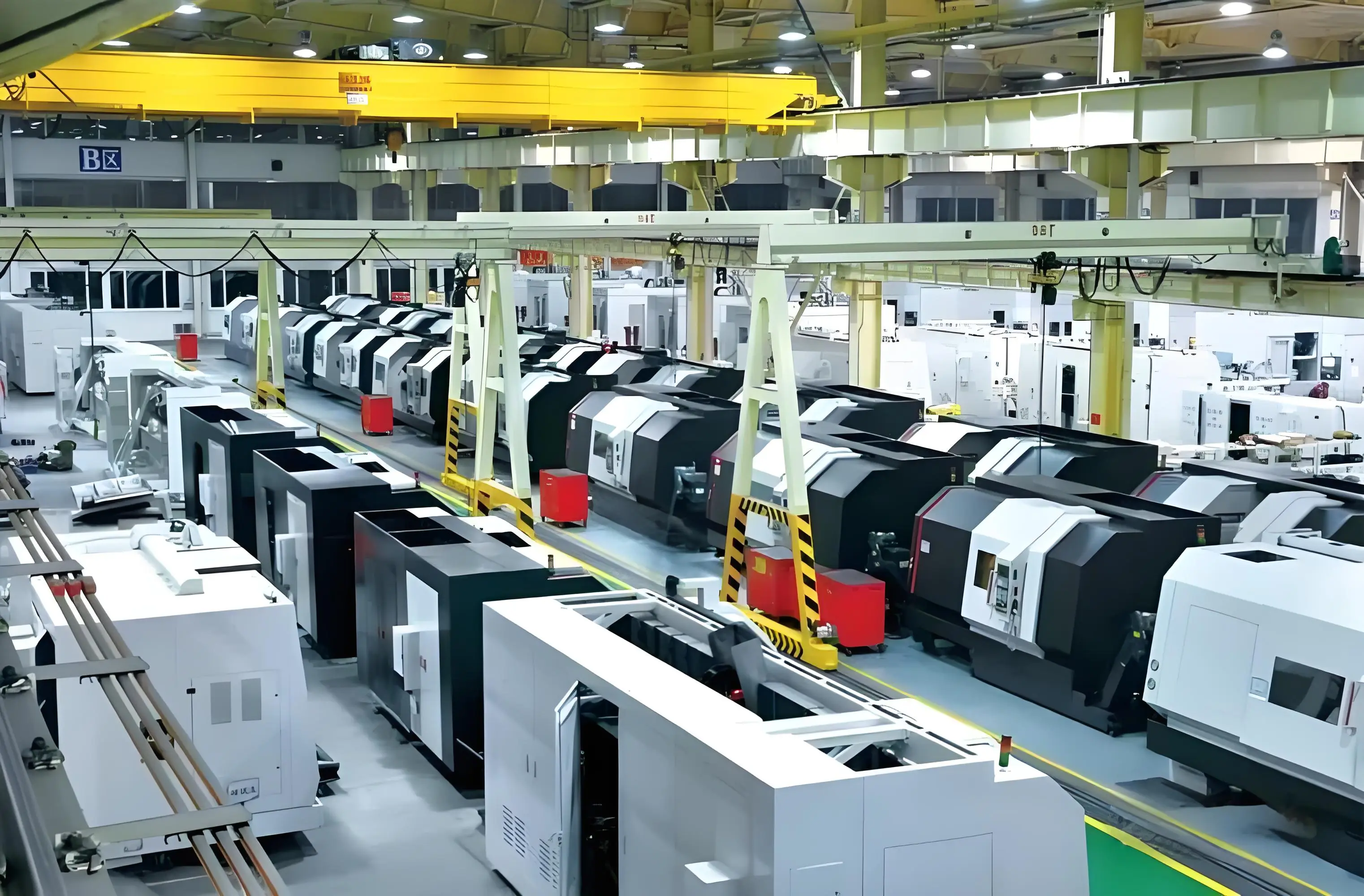
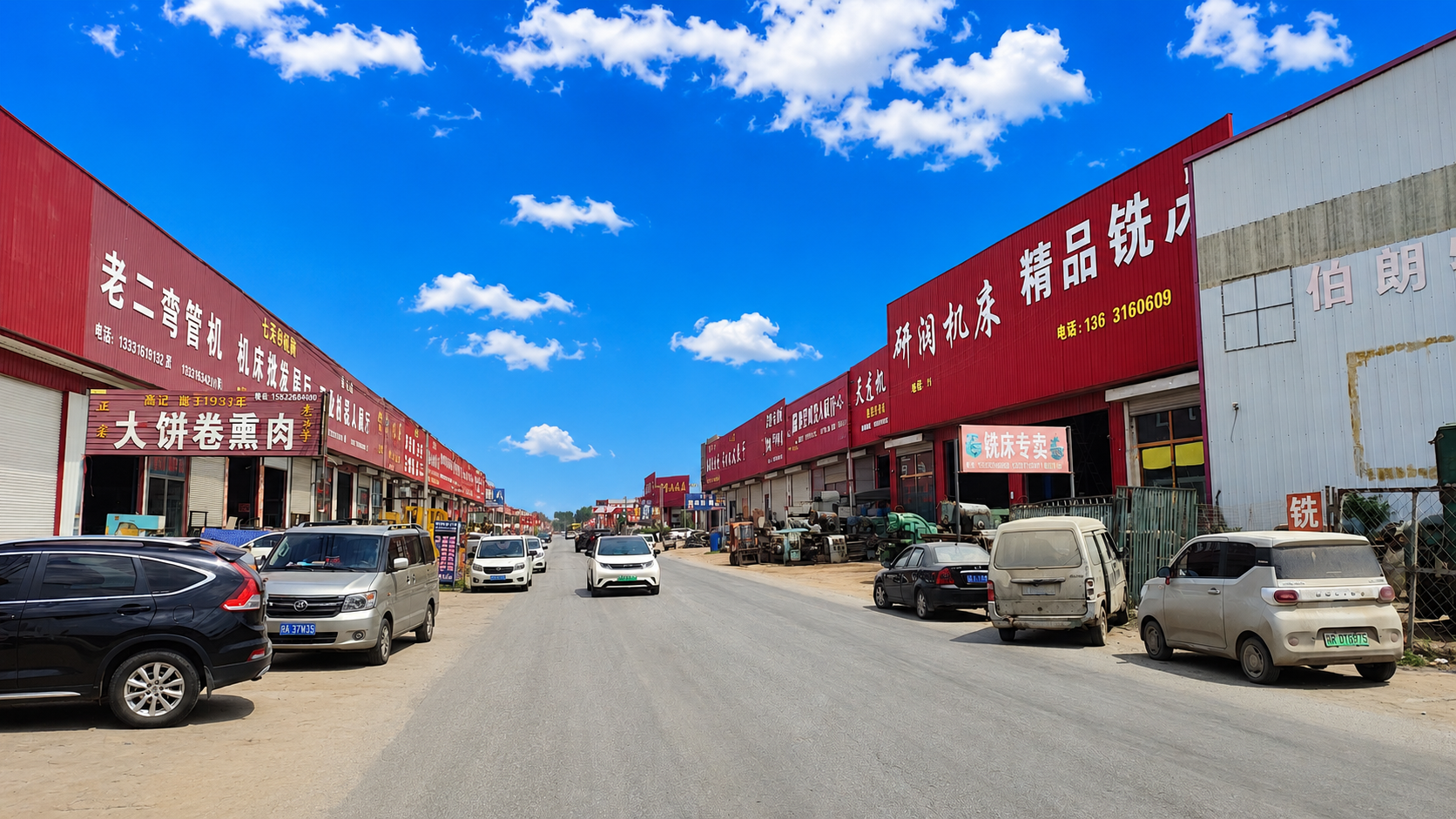
Wen'an, located in Langfang City, Hebei Province, China, is the largest offline distribution hub for used machine tools in northern China and a nationally recognized export base for second-hand industrial equipment. Its core market areas span Zhaogezhuang Town and Daliuzhen Town, adjacent to Tianjin Port — the core seaport in northern China. With a massive stock of ready-to-ship equipment, a mature industrial chain for refurbishment, and outstanding cost performance, it has become a core sourcing destination for manufacturing enterprises in Russia, Central Asia, Southeast Asia and other regions.
1. Basic Market Overview
- Industrial Scale: The market is home to over 2,500 fixed operating merchants and more than 500 mobile traders, with approximately 15,000 employees. Tens of thousands of machines are kept in stock year-round, covering all categories of general metal processing equipment. Its annual equipment circulation accounts for nearly 40% of North China, making it the core hub for used machine tool trading in northern China.
- Export Activity: Export sales account for 10%–18% of the market's total transaction volume, with a steady growth trend in recent years. In the early stage, overseas merchants mainly purchased goods on-site, while the proportion of online inquiries and remote entrusted procurement continues to rise.
- Core Export Destinations: 1. Russia and the five Central Asian countries: The largest overseas market, with strong demand for conventional lathes, milling machines and forging equipment, supported by smooth road and sea transport channels. 2. Southeast Asia (Vietnam, Thailand, Malaysia, Indonesia): The fastest-growing market, with relatively higher requirements for equipment condition and production year. 3. Middle East, North Africa, South America: Stable scattered orders, mainly for general-purpose and cost-effective equipment.
2. Core Equipment Categories Available for Procurement
Wen'an market has a complete range of equipment, allowing one-stop procurement of full-process metal processing equipment. Exports are dominated by general-purpose and cost-effective models: 1. Metal Cutting Machines (Largest Export Volume) Including conventional lathes, vertical/horizontal milling machines, grinding machines, drilling machines, planers, boring machines and other conventional models, as well as economical CNC lathes, vertical machining centers, CNC milling machines and other CNC equipment. Brands are mainly domestic first-tier brands, and some imported Japanese, Korean and European and American models are also in circulation. 2. Metal Forming / Forging Equipment Mechanical/hydraulic punch presses, shearing machines, press brakes, hydraulic presses, leveling machines, etc., are popular procurement categories for hardware and sheet metal processing customers. 3. Other Special Equipment Gear processing equipment (gear hobbing machines, gear shaping machines), band saw machines, wire cut EDM machines, die casting machines and other supporting industrial equipment.
Important Compliance Notice: High-precision five-axis linkage machining centers, high-end CNC systems and some equipment are subject to China's dual-use item export controls, and special licenses are required for export — not all models can be exported freely. Please confirm the export compliance of the equipment with the supplier before purchasing.
3. Core Advantages of Sourcing from Wen'an
- Massive Spot Inventory for One-Stop Consolidated Procurement The market maintains a large stock of equipment of different brands, models and conditions year-round. Buyers can select multiple units of different categories at one time and consolidate them into containers, greatly reducing procurement and logistics costs. There is no need to wait for production cycles, and shipment can be arranged shortly after payment to put into production quickly.
- Outstanding Cost Performance The price of used machine tools of the same model is usually only 30%–60% of that of brand-new equipment. As a source distribution market, there are fewer intermediate circulation links, and the purchase price is lower than most regional second-hand dealers, which can effectively reduce the initial production cost of factories.
- Mature Refurbishment and Custom Adaptation Capabilities The locality has a complete maintenance and refurbishment industrial chain with sufficient professional technicians. It can complete customized transformations such as complete equipment overhaul, accuracy calibration, appearance refurbishment, and voltage/frequency adaptation (such as adapting to 380V/220V, 50Hz/60Hz) according to the needs of the purchasing country, ensuring that the equipment can be put into production directly after arrival.
- Superior Location and Convenient Export Logistics It is only about 100 kilometers away from Tianjin Port, with low cost and fast timeliness for land transportation of large equipment to the port. There are a large number of local freight forwarders, foreign trade agents and inspection institutions familiar with the export of used electromechanical products, which can provide full-chain export services from machine inspection to customs declaration and shipping. Relying on Tianjin Port routes, it can cover major global markets such as Southeast Asia, the Middle East, Europe and Africa. For Russia and Central Asia, it can be transported by road or China-Europe Railway Express with stable channels.
4. Mainstream Procurement Methods
Most local merchants in Wen'an are physical operators focusing on domestic spot transactions, and most do not directly have import and export operation rights. Overseas buyers mainly complete procurement through the following three methods: 1. On-Site Procurement (Traditional Mainstream Mode) Buyers or their entrusted inspectors visit the Wen'an market in person, check the equipment condition one by one on site, test the performance by starting the machine, and negotiate the price on site. After confirming the purchase, they entrust a local foreign trade agency to handle the full set of procedures such as export customs declaration, inspection and logistics. Features: High transaction transparency, direct verification of equipment status, suitable for orders with large purchase amounts and high requirements for equipment accuracy. 2. Online Communication + Third-Party Entrusted Inspection Obtain equipment information through supplier official websites or international B2B platforms, communicate parameters and prices online, and entrust a third-party authoritative inspection agency (such as CCIC, China Certification & Inspection Group) to conduct on-site machine inspection and issue an official inspection report. Payment and delivery are made after confirming that the equipment status is correct. Features: No travel cost, suitable for repeat customers or small and medium-sized orders. 3. Full-Service Package from Foreign Trade Companies Directly cooperate with Chinese foreign trade companies experienced in used electromechanical export. They are responsible for the whole process of product selection, price negotiation, machine inspection, reconditioning and export in the Wen'an market. Buyers only need to confirm the equipment list, technical requirements and final price. Features: Worry-free operation. The professional team can handle professional issues such as compliance and customs clearance documents, suitable for first-time buyers or customers unfamiliar with the Chinese market.
5. Quality Assurance and Inspection Standards
- Local Basic Reconditioning Specifications Merchants usually complete basic maintenance for equipment for export: ensuring the normal operation of spindles, guide rails and transmission systems, safe and reliable electrical systems, and cleaning and refurbishing the appearance. Before purchase, you can explicitly request a test run and geometric accuracy inspection.
- Official Pre-Shipment Inspection (CCIC) Before export, you can entrust the China Certification & Inspection Group (CCIC) to conduct pre-shipment inspection on the equipment and issue an official certificate. This certificate is recognized by customs of most countries around the world, is the core document for customs clearance in the destination country, and can also serve as a third-party authoritative certification of the equipment status. The core inspection contents include: authenticity of equipment nameplate information, integrity of safety protection devices, electrical safety performance, basic operation functions, and environmental compliance (no waste oil or waste liquid leakage, etc.).
- Procurement Recommendations There are individual differences in the condition and usage history of used machine tools. It is recommended to prioritize equipment that can be tested on site, or entrust a third-party agency for inspection. Focus on checking the equipment nameplate, model and production year to ensure that the information is consistent with the declaration and avoid affecting customs clearance in the destination country.
6. Logistics, Customs Clearance and Trade Terms
- Export Logistics Channels - Sea freight: Equipment is transported by land from Wen'an to Tianjin Port for loading and shipped to major ports around the world, suitable for Southeast Asia, the Middle East, Africa, Europe and other regions. - Land transport / railway express: Shipped to Russia and Central Asia via road transport or China-Europe Railway Express, with stable timeliness, suitable for landlocked countries.
- Export Customs Declaration Method Used machine tools in Wen'an are mainly exported through formal customs declaration under general trade (customs supervision code 0110), with complete documents throughout the process, which can normally handle foreign exchange settlement and destination country customs clearance.
- Common Trade Terms FOB Tianjin Port is the most common in the industry. Terms such as EXW (delivery at the market site), CIF/CFR destination port can also be negotiated according to demand.
- Destination Country Customs Clearance Tips Different countries have different access rules for the import of used electromechanical products, for example: - Vietnam: Restricts the import of used equipment produced more than 10 years ago, with high requirements for equipment condition. - Russia and Central Asia: The access threshold is relatively loose, and the CCIC inspection certificate can basically meet the customs clearance requirements. It is recommended to confirm your country's import policies and qualification requirements for used electromechanical products before purchasing to avoid return losses caused by failure of customs clearance after the goods arrive at the port.
7. Common Payment Methods
The mainstream payment methods in the industry can be negotiated with suppliers: - Telegraphic Transfer (T/T): The most common method, usually 30% deposit in advance, and the balance paid before shipment after the equipment passes the inspection. - Letter of Credit (L/C): Suitable for large-value orders, with bank-guaranteed transactions, which is more secure for the rights and interests of both buyers and sellers.
8. Procurement Precautions
- Confirm Compliance Risks in Advance Confirm two types of compliance in advance: first, whether the equipment is within the scope of China's export controls; second, whether the equipment meets the import access standards of used electromechanical products in your country to avoid compliance risks.
- After-Sales Description Used machine tool exports usually do not include on-site warranty services. Suppliers generally provide remote technical guidance and supply of wearing parts. It is recommended to purchase common wearing parts and tool accessories at the same time during procurement to reduce subsequent maintenance costs and downtime.
- Price Matching with Condition The price of equipment in the market is directly linked to condition, brand, accuracy and year. Too low quotations often correspond to poor equipment condition or long service life. It is recommended not to simply take the lowest price as the selection criterion, but comprehensively evaluate the cost performance of the equipment.
- Transaction Security Prioritize merchants with long operating history and good industry reputation, or cooperate with formal foreign trade companies to ensure the safety of transaction funds and goods.
9. Typical Procurement Process
- Demand confirmation: Clarify the required equipment model, parameters, condition requirements and procurement budget.
- Product selection and price negotiation: Screen equipment through online channels or on-site, and confirm the price and delivery conditions with the supplier.
- Machine inspection and confirmation: Conduct on-site test run, or entrust a third-party inspection agency to issue an inspection report to confirm that the equipment status meets the requirements.
- Sign a procurement contract and pay the deposit.
- Equipment reconditioning: Complete refurbishment, voltage adaptation, accuracy calibration and other work as required.
- Conduct pre-shipment inspection and go through export customs declaration procedures.
- Pay the balance and arrange loading / shipment.
- Deliver a full set of customs clearance documents, and complete customs clearance and pick-up after the goods arrive at the port.